
Downloads on the website
The menu item types
| Type | Shows | Important settings |
|---|---|---|
| Categories | The categories below the chosen root as tiles or as a compact list, with image, description, number of downloads and subcategories | Root category, layout, top level category description, category image, description, show number, levels (1 = without subcategories) |
| Category | The downloads of a category and its subcategories | Layout, ordering, number per page, category image and its layout, details (size, version, date, counter, tags), show locked downloads |
| Single download | The page of a download | Send the file directly instead of showing the page |
| Latest downloads | The most recently created downloads | Number, categories, period in days |
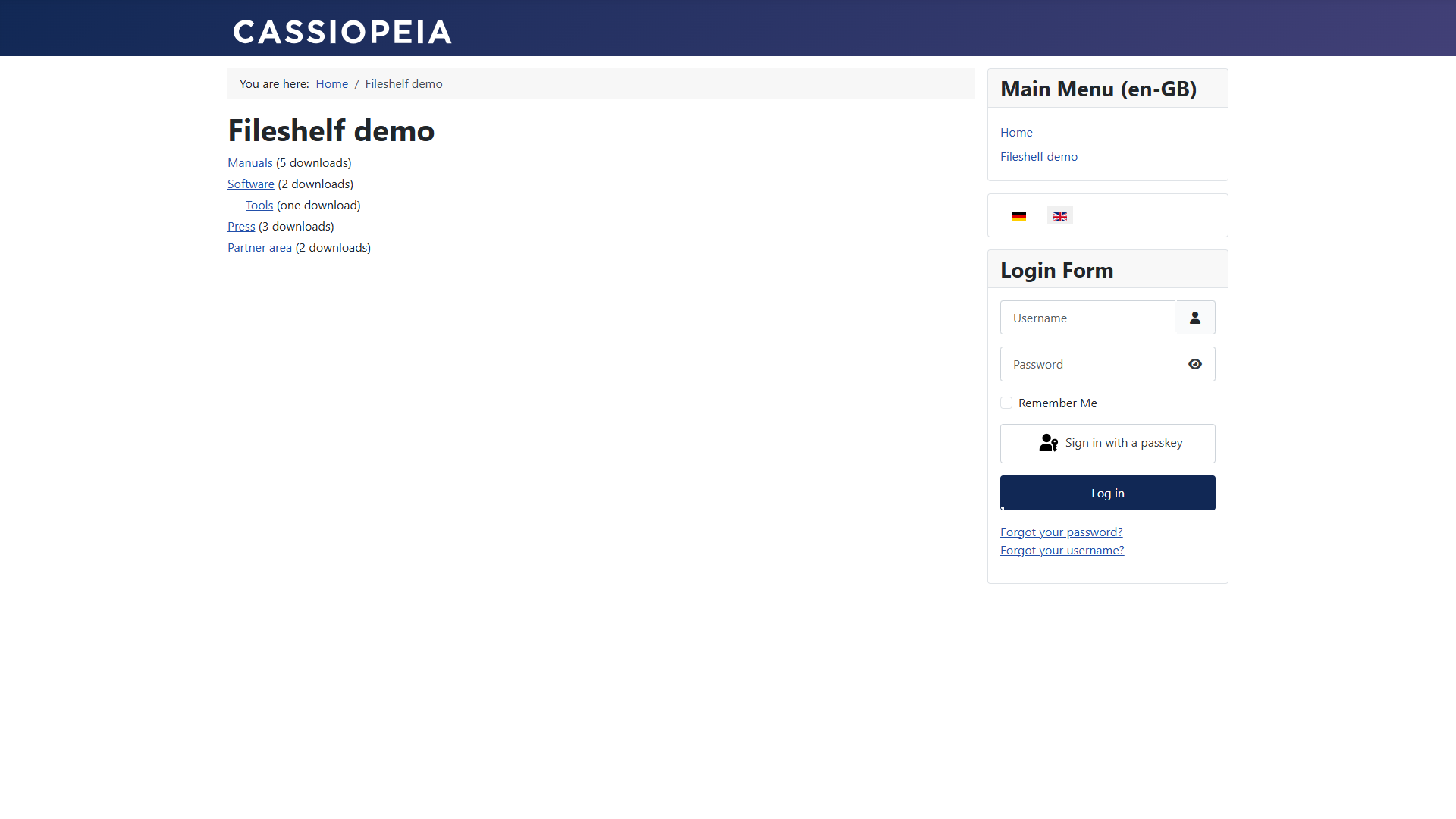
Above the tiles stand title, description and image of the chosen root category (switched off in the menu item under “Top Level Category Description” and “Category Image”). Every tile has an image area in the format 16 : 9; the image is fitted, never cropped, so logos stay whole.
Category image and description
At the top of every category stand its title, description and the image from the field “Image” of the category. The image stands beside the text, at most 220 × 160 pixels and never cropped; on narrow screens it stands above. If you like, it appears as a banner across the full width in the format 3 : 1 – good for photos, but cropped. You choose both in the options or per menu item (“Category Image”, “Category image layout”). The alternative text comes from the image field of the category; with “No Description” ticked there, the image counts as decoration.
Headings
Every page has exactly one main heading (h1). In a category it is its title – or the page heading of the menu item when “Show Page Heading” is on and the menu item shows this very category. Below it the small sections Subcategories and Downloads structure the page (h2), the downloads in them are h3. The section Downloads only stands where subcategories stand above it; without it the downloads themselves are h2. The line with the number of downloads (“12 downloads”) appears only after a search or a filter and with several pages. Both can also be set to always or never, in the options and per menu item. Pages without a title of their own, such as “Latest downloads”, keep their main heading with the page heading switched off – then for screen readers only. This helps screen readers and search engines.
Heading and introduction of the overview
Above the categories of the download overview a heading and an introduction of your own can stand. Enter both in the Fileshelf options (tab “Display”) for every overview, or in the menu item of the overview for that one only; an empty field in the menu item takes the value from the options. A heading entered there is the main heading of the page and is always shown, even with “Show Page Heading” off. Without one, the rules above apply.
Browser page title
The “Browser Page Title” of a menu item (tab “Page Display”) applies to the page the menu item shows: the overview, the category, the download or “Latest downloads”. Pages below it, such as a subcategory, carry their own title. The site name is added if Joomla's global configuration says so.
Three layouts of a category
Each layout leads through the categories in its own way. You choose it in the menu item, in the category (tab “Fileshelf: Display”) or for all in the options.
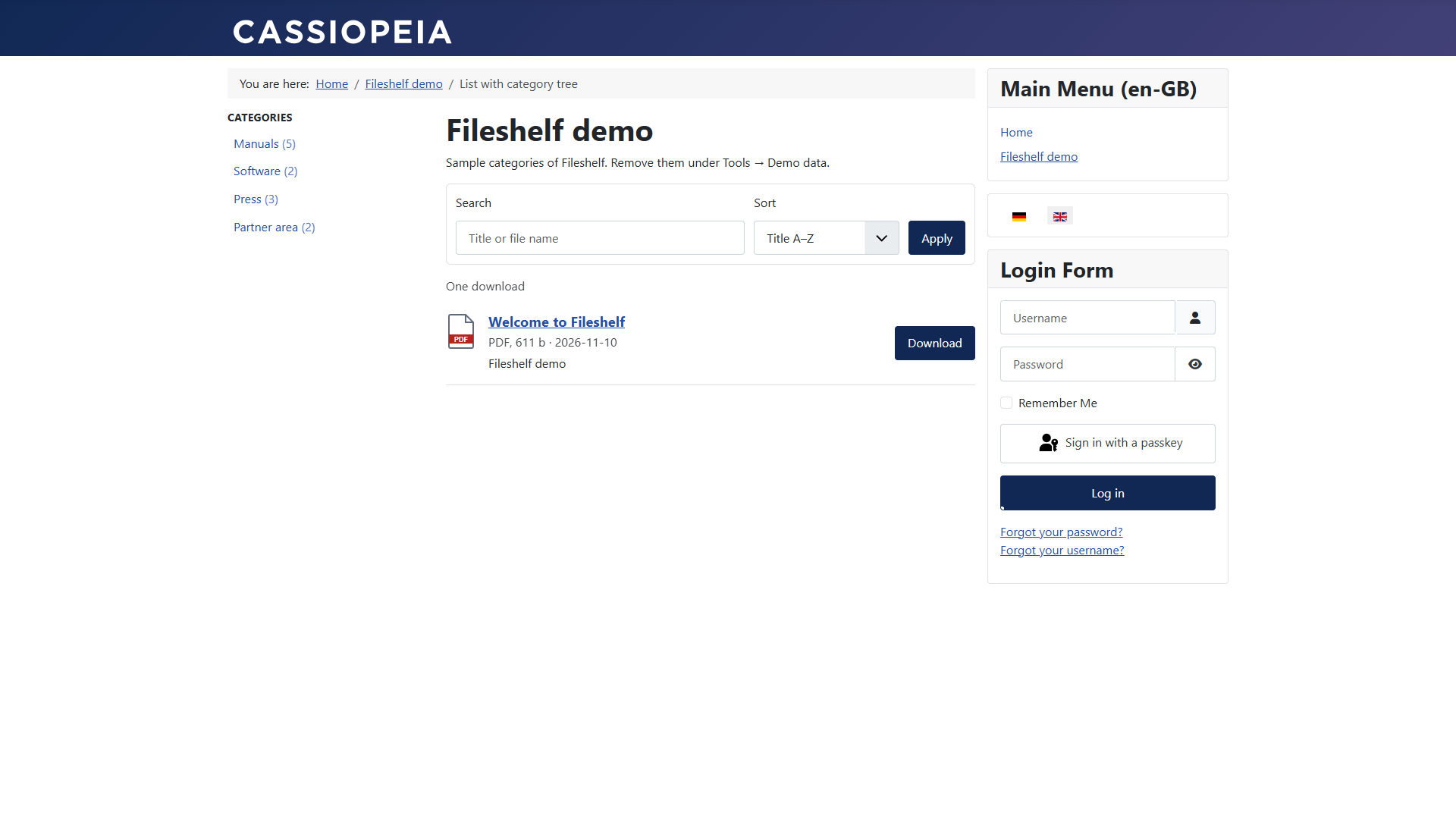
- List with category tree (default) – on the left the tree of the categories below the menu item, with the number of downloads; it opens only along the way to the category shown. On a phone it stands below the list.
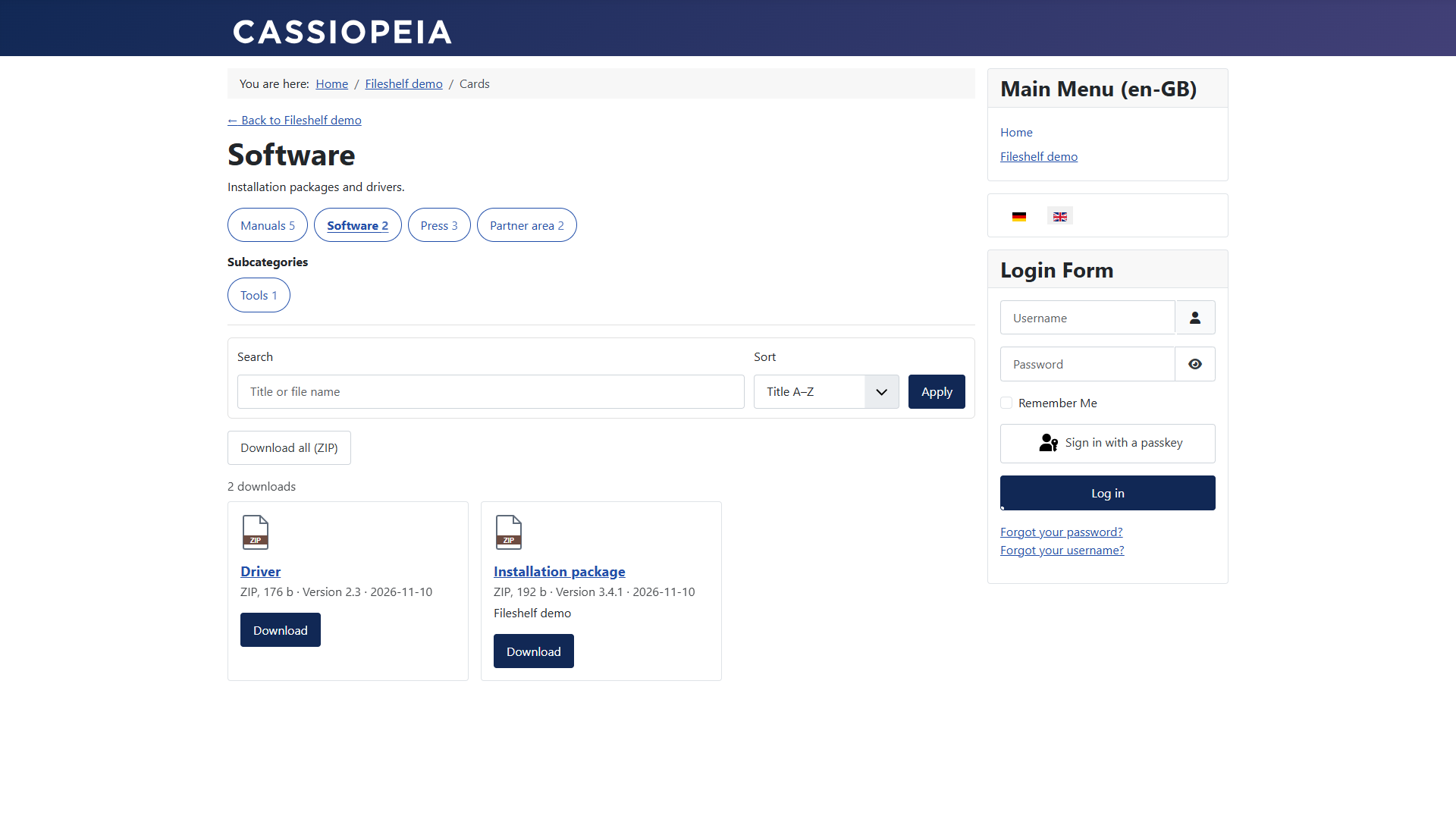
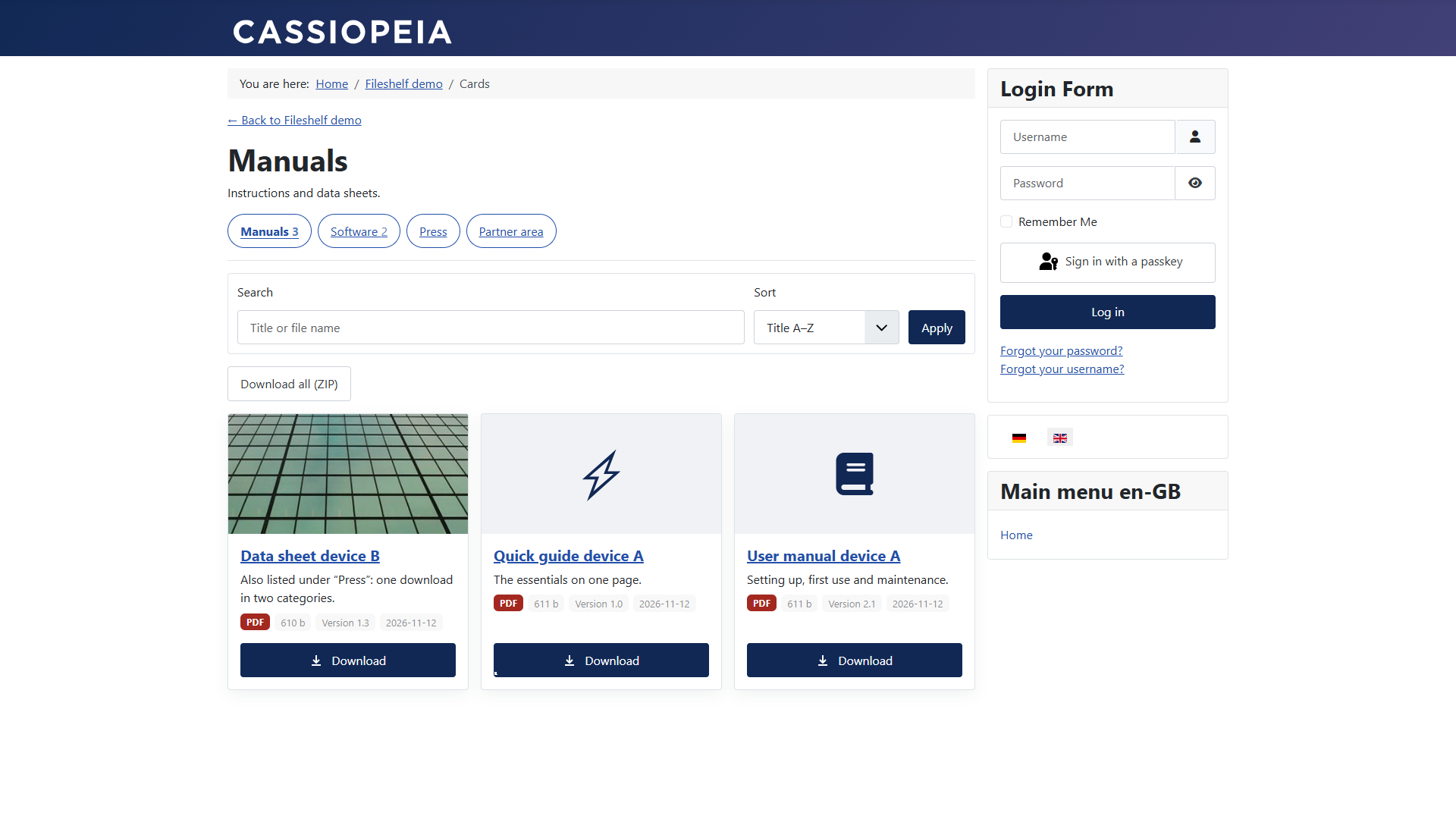
- Cards – above the downloads the way back to the parent category and the subcategories (without subcategories the categories of the same level); the downloads as cards.
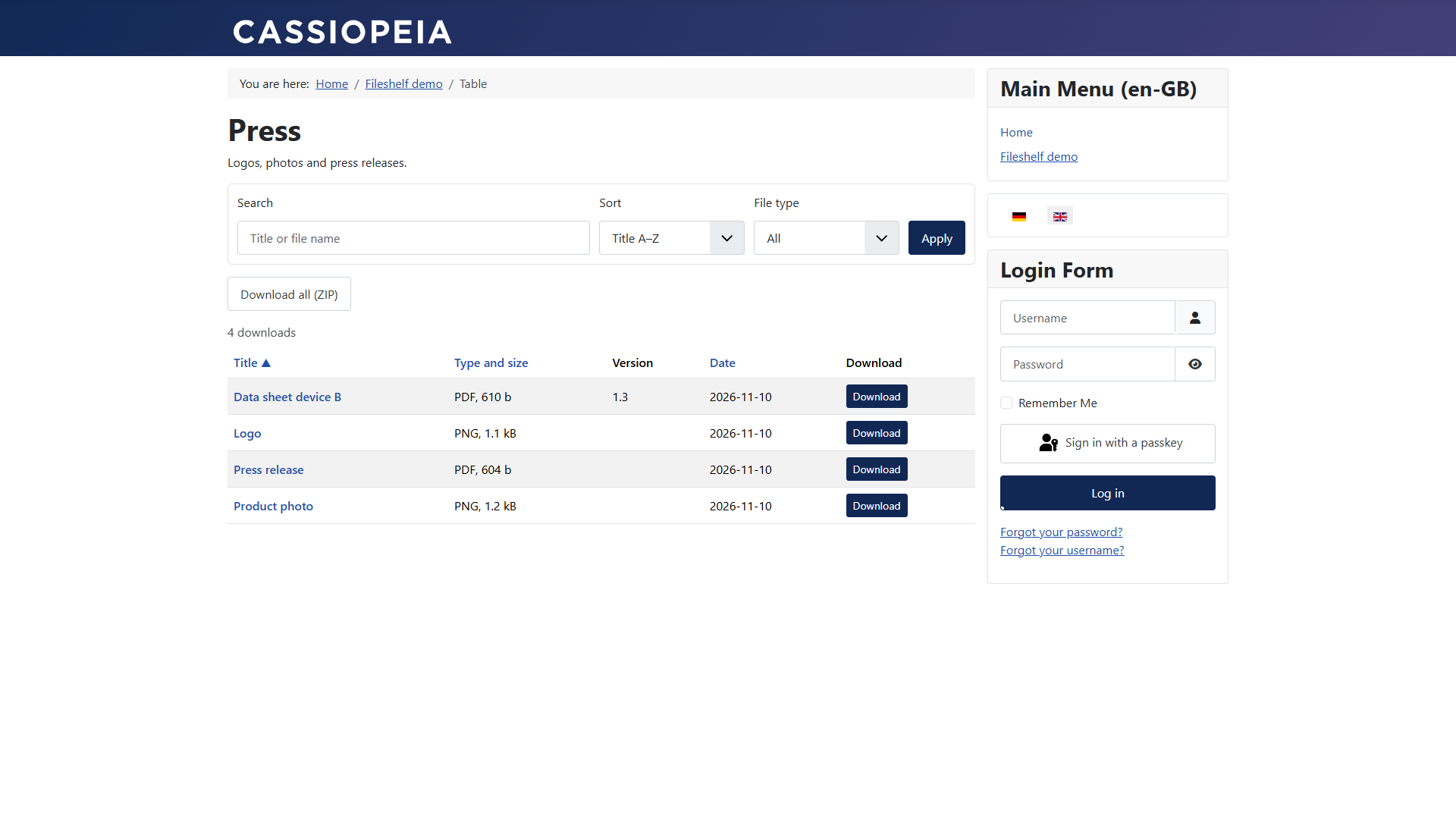
- Table – “Change category” as a choice, the subcategories to click, the downloads as a table whose column headers sort. On narrow screens every row becomes a block with labelled values.
In every layout the file type stands as a coloured label (“PDF”, “ZIP” …); the colour helps to scan, the word names the type.
Without a page per download
Every download has a page of its own with description and details. To list downloads with a direct link only, set A page per download to “No” in the options (tab “Display”) or in the menu item. Then:
- The title leads straight to the file, with the same checks as the button “Download”, which stays. If a download needs a password or a login, the note beside it shows the way.
- Old addresses of the page lead permanently (301) to the file. A menu item “Single download” for exactly this download keeps showing its page.
- The module, the shortcodes, YOOtheme, the search, the mails of notifications and the editor dialog then link the file as well.
- What is only on the page is missing on the website: “Notify me” and the earlier versions (Pro version). The form and unlocking of a link (Pro version) are reached through the note.
Above the list visitors can search (title and file name), sort and – with several file types – filter by type. The choice is part of the address, so a filtered link can be passed on. Switch it off with Search and sorting in the menu item or in the options. Joomla's breadcrumbs show the way from the menu item to the category or the download.
Fileshelf takes the look of buttons, fields and tables from the template: every button carries the classes of
Bootstrap (Cassiopeia and many other templates) and of UIkit (YOOtheme Pro) at once. For more, create overrides for
com_fileshelf/category and the layout fileshelf/item.
Locked downloads
Downloads whose access level the visitor lacks are hidden. With Show locked downloads
(options or menu item) they appear with athe reason of the lock and a linkbutton with a lock that leads to logthe in.login.
Password-protected downloads always stand in the list, with the linkbutton Enter password.
The page of a download
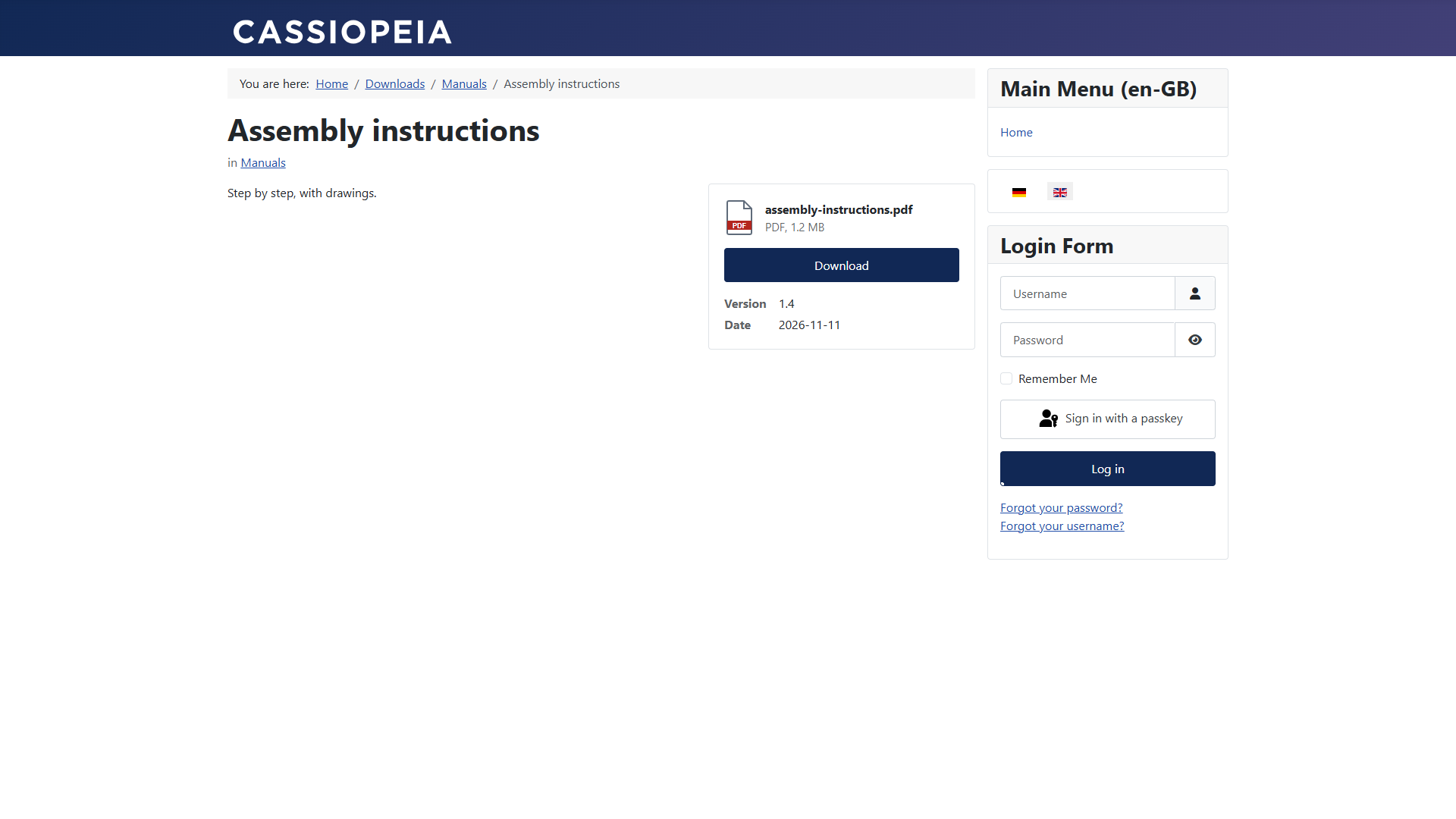
The download box names the file with type and size, carries the button Download (or the lock with its reason) and the details version, date and – if switched on – the number of downloads. On request it shows the checksum (SHA-256) to unfold, so visitors can verify a downloaded file; it is switched on in the options or in the menu item “Single download”. In a narrow area – on a phone or in a narrow column – the box stands above the description.
If a download appears in several categories, its page tells search engines that the address under the main category is the authoritative one (canonical). So it does not count twice.
Addresses
With search engine friendly URLs switched on, the addresses look like this:
- Page of a download:
…/price-lists/price-list-2026 - File:
…/price-lists/price-list-2026/file - Password form:
…/price-lists/price-list-2026/unlock
The option Remove IDs from URLs (Options → Integration) decides whether the number of the download stands in the address. The alias of a download must be unique per category.