# Optimisation and image editor
Besides cleaning up, Media Organizer can also shrink and edit images. Both are **reversible** and run **strictly locally** — no image is sent to an online service.
## The optimisation report
The report shows images with optimisation potential, measured against the thresholds from the options. It is a recommendation — nothing is changed until you trigger it.
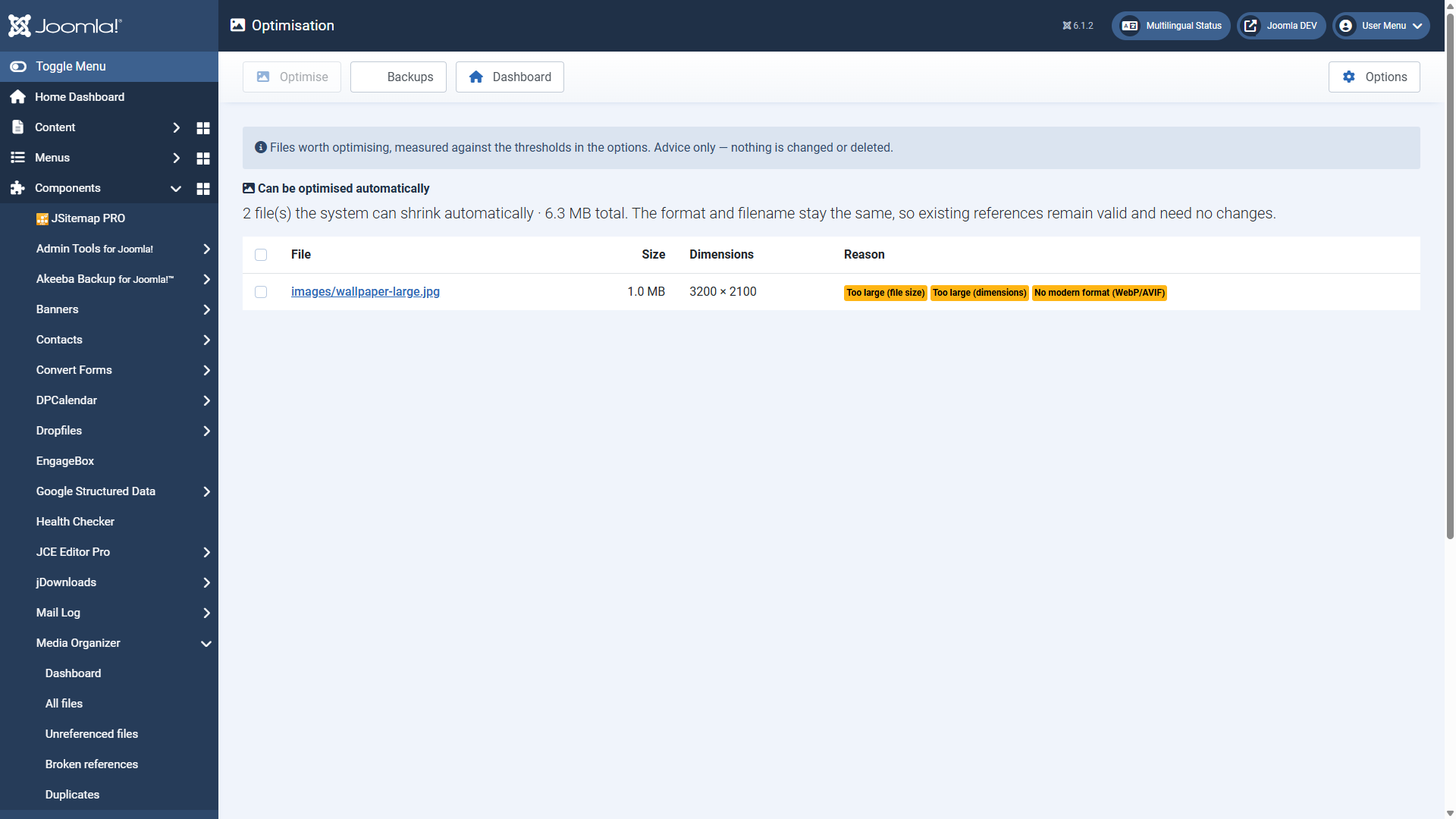 For every file it says *why* it was flagged — here for three reasons at once.Typical reasons:
- **Too large (file size)** — exceeds the configured maximum file size (default 500 KB).
- **Too large (dimensions)** — exceeds the maximum edge length (default 2500 px).
- **Not a modern format (WebP/AVIF)** — a raster image that would be considerably smaller as WebP or AVIF.
- **Outdated format** — BMP or TIFF, for instance.
### Two groups — and the difference matters
The report deliberately separates them:
**Automatically optimisable.** Format and file name stay the same. Existing references stay valid and do not have to be adjusted. This is the safe case.
**In the editor only.** Here an optimisation would change the format (to WebP, for example) and therefore the file name. Existing references still point to the old file and are **not** switched over automatically. Such images are therefore never touched automatically.
### Triggering optimisation
Select the files and click **Optimise**. Before that the following applies:
- The **original is backed up** (default: `jimgo_optimize_backup`, outside the web).
- Nothing is **ever scaled up** — only down.
- If the optimisation brings less than the **minimum saving** (default 10 %), the original stays untouched. No loss of quality for a few kilobytes.
- Very large images are skipped so that decoding stays within memory — they appear as "too large to process".
Via **Backups** you reach the saved originals and can undo an optimisation.
### External optimisers
If specialised encoders are installed on the server, Media Organizer uses them for compression — that brings considerably more than the built-in libraries:
Format
Tools
Note
JPEG
jpegoptim
—
PNG
pngquant, oxipng, OptiPNG
**pngquant is lossy** (the biggest saving); oxipng and OptiPNG are lossless. Automatic prefers pngquant.
WebP
cwebp
When the source is already WebP.
GIF
gifsicle
Keeps animations.
Media Organizer **downloads nothing and ships nothing along** — it only uses what is already installed. If a tool is missing, it falls back to the built-in library automatically. Under **Options → optimisation → available optimisers** you see what was detected.
## The image editor
You open the editor from the detail view via **Edit**.
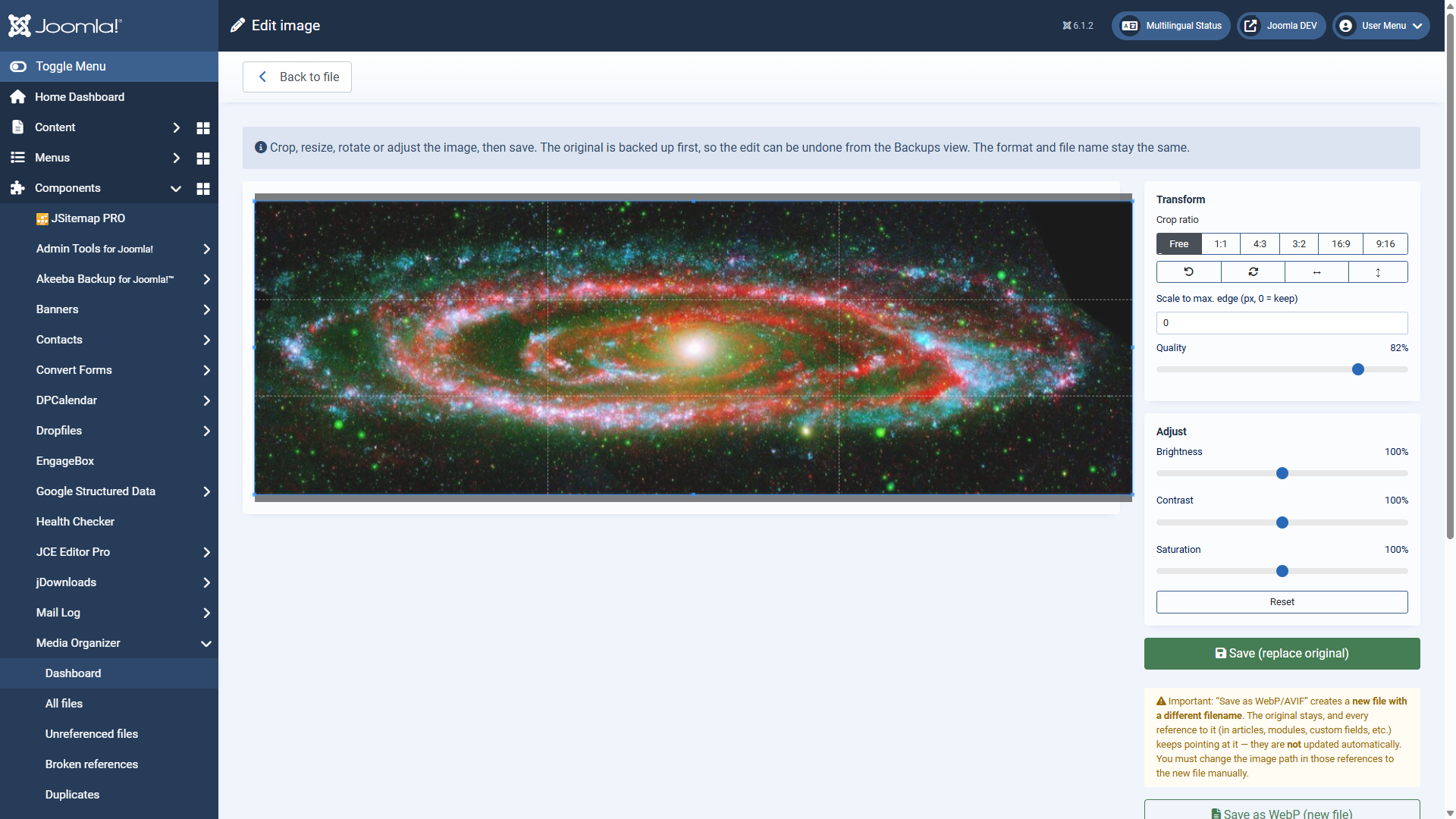 Crop, rotate, scale, quality and image adjustment — with a preview.Possible are:
- **Cropping** — freely or with a fixed ratio (1:1, 4:3, 3:2, 16:9, 9:16)
- **Rotating and flipping**
- **Scaling** to a maximum edge length
- Setting the **quality**
- **Adjusting** brightness, contrast and saturation
Here too the original is backed up beforehand; through the backups view you undo the edit.
### Saving: two routes with different consequences
Route
What happens
References
**Replace the original**
Format and file name stay the same.
stay valid ✓
**Save as WebP/AVIF**
Creates a **new file with a different file name**. The original remains.
still point at the original — you have to switch them over **manually**
This is the most common stumbling block. If you save an image as WebP, *nothing* changes in your content — it still points at the old file. The occurrences you have to adjust are listed in the detail view of the original under "referenced by".
## Where to go from here
- [Automation: scheduled scans and 404 monitoring](https://docs.graup-it.de/books/media-organizer-en/page/automation-scheduled-scans-and-404-monitoring)
- [The command line](https://docs.graup-it.de/books/media-organizer-en/page/the-command-line)
Applies to version 1.2.0.
[Deutsche Fassung](https://docs.graup-it.de/link/71)